Apps Answered. APIs Opened Data. MCP Lets Agents Use It.
Open API opened data carefully. Open MCP is the same lesson for agents that discover and call curated tools — with humans still co-signing money and contract.
Rick Low · Hong Kong
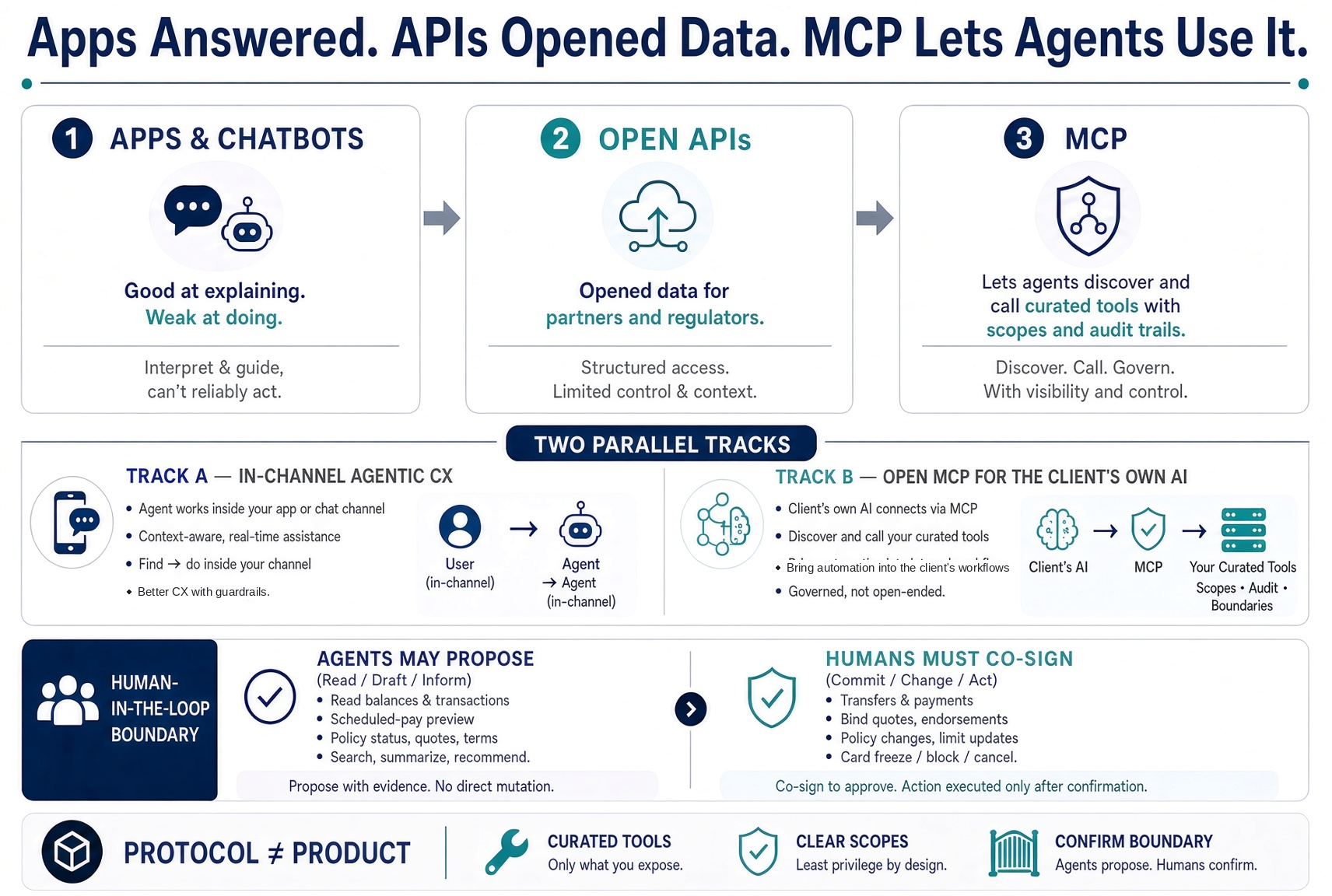
Client-facing banking and insurance still live mostly where they have for a decade: the app, the branch flow, and a chatbot that answers FAQs. That stack is good at explaining. It is weak at doing once the work has moved into the client’s own AI tools — copilots, custom agents, and assistants that already sit next to email and calendars.
The next step is not another skin on the same chatbot. It is a deliberate product surface for agents: permissioned, auditable tools they can discover — with humans still co-signing money and contract.
This follows the same arc as open banking. We opened APIs for partners and regulators. We now need a clean way for agents to use curated capabilities without turning every endpoint into an unsupervised write.
The problem is not “more chat”
Apps and scripted bots keep the customer inside your UI. Open APIs helped developers and partners move data and, in some markets, initiate payments. Neither fully serves a conversational agent that needs a short list of named tools, clear scopes, and an audit trail of what it proposed versus what a human released.
Two things are true at once:
- Clients already run AI outside your app.
- Regulated obligation still sits with the institution — and with a named human when money or contract moves.
Treat those as one product problem, not a chatbot polish job.
Track A — Agentic CX inside the channel
Several institutions are already shipping in-app agents that find and do inside their own surfaces. Public examples include DBS Joy (find → do in the bank experience), Commerzbank Ava, and Ping An’s AI Express Service. These matter. They raise the bar for what “good” feels like in the app.
They are also a different job from meeting the client in their AI stack. Capgemini’s World Cloud Report in Financial Services 2026 (Nov 2025) still shows high intent and low scale for AI agents across banking and insurance — about 80% in ideation or pilot, about 10% at scale. Early. Not done. Useful as a caution against declaring victory after a pilot chatbot.
Keep Track A on its own roadmap: better in-channel agentic CX.
Track B — Open API → Open MCP (out of app)
Open APIs opened data (and often payment initiation) for apps and partners. Model Context Protocol (MCP) is the analogy for agents: a way for an agent to discover and call shared tools and context — not a peer-to-peer “agent chat network,” and not a replacement for the REST governance you already run underneath.
Market proof is already public:
- HSBC HSBCnio positions MCP so clients can bring accounts, payments information, and FX context into their own AI tools. Public documentation looks like discover / read / status. “Ask HSBC” is still framed as coming soon — so do not read that surface as Confirm-on-pay.
- Danske Bank has published an MCP bridge toward its Premium APIs — same pattern: bank capabilities exposed for the client’s AI, not a claim that unsupervised money movement is live retail CX.
Vendor platforms show where gated writes are heading — initiate or preview, then human tap / officer decision / scoped token (patterns visible from Mercury, Blend, Nymbus, and insurance stacks such as Aron and Openkoda). Treat those as vendor patterns, not as what every bank MCP already does.
Trap: protocol ≠ product. Shipping an MCP server is not the same as a safe client-facing agent product. You still need tool curation, RBAC, PII handling, evals, and a Confirm boundary. Immature agent-to-agent overlays do not remove the need to back MCP with the same discipline you put on APIs.
Keep Track B parallel to Track A. Merging “in-app Joy” and “out-of-app MCP” into one slide overclaims.
HITL — propose is not co-sign
Chatbots answered. Agents propose. Humans co-sign money and contract.
Read / draft / inform
- Balances and transactions
- Policy status; quote parameters
- Card status; KYC / document checklist
- Scheduled-payment preview
Named release
- Transfer / pay bill
- Quote → bind; endorsement
- Renew / cancel; card freeze / limit
- Beneficiary add; credit / loan disburse
Forbidden to the agent alone: override risk or AML holds; clear sanctions hits; change identity / KYC outcome; mute or rewrite the audit log; broaden MCP scopes mid-session; run destructive core or policy-admin writes without preview and Confirm.
High-confidence drafts can go to a summary queue. Low confidence or a rule break goes to full review with mandatory override notes. That is the operating model — not a slogan.
Thesis
Open API taught us to open carefully. Open MCP is the same lesson for agents that discover and use shared tools.
Close
Winners will treat agent interfaces as a product surface: curated tools, clear scopes, evals above the protocol, and a Confirm boundary designed before the tool count scales.
Question for the operating committee: which money and contract actions are named-release only — and which read tools are safe to expose to the client’s AI this quarter?